A real look at which airlines carry Starlink in the premium cabin, what speeds you can actually expect, and how to upgrade without leaving money on the table.
Last reviewed: June 15, 2026
Starlink aviation business class refers to business-class cabins on select airlines equipped with SpaceX's low-earth-orbit satellite internet. Unlike older Ku-band or Ka-band systems, Starlink delivers consistent speeds—often 50–200 Mbps per plane—that hold up over oceans and remote corridors where legacy in-flight Wi-Fi struggles or fails entirely. As of 2026, a small but growing number of carriers have rolled it out fleet-wide or on specific routes, and the experience in premium cabins differs meaningfully from economy because of bandwidth allocation and seat-level power infrastructure. If you need real-time help finding which routes carry it, +1-833-894-5333 connects you to agents who track live fleet configurations.
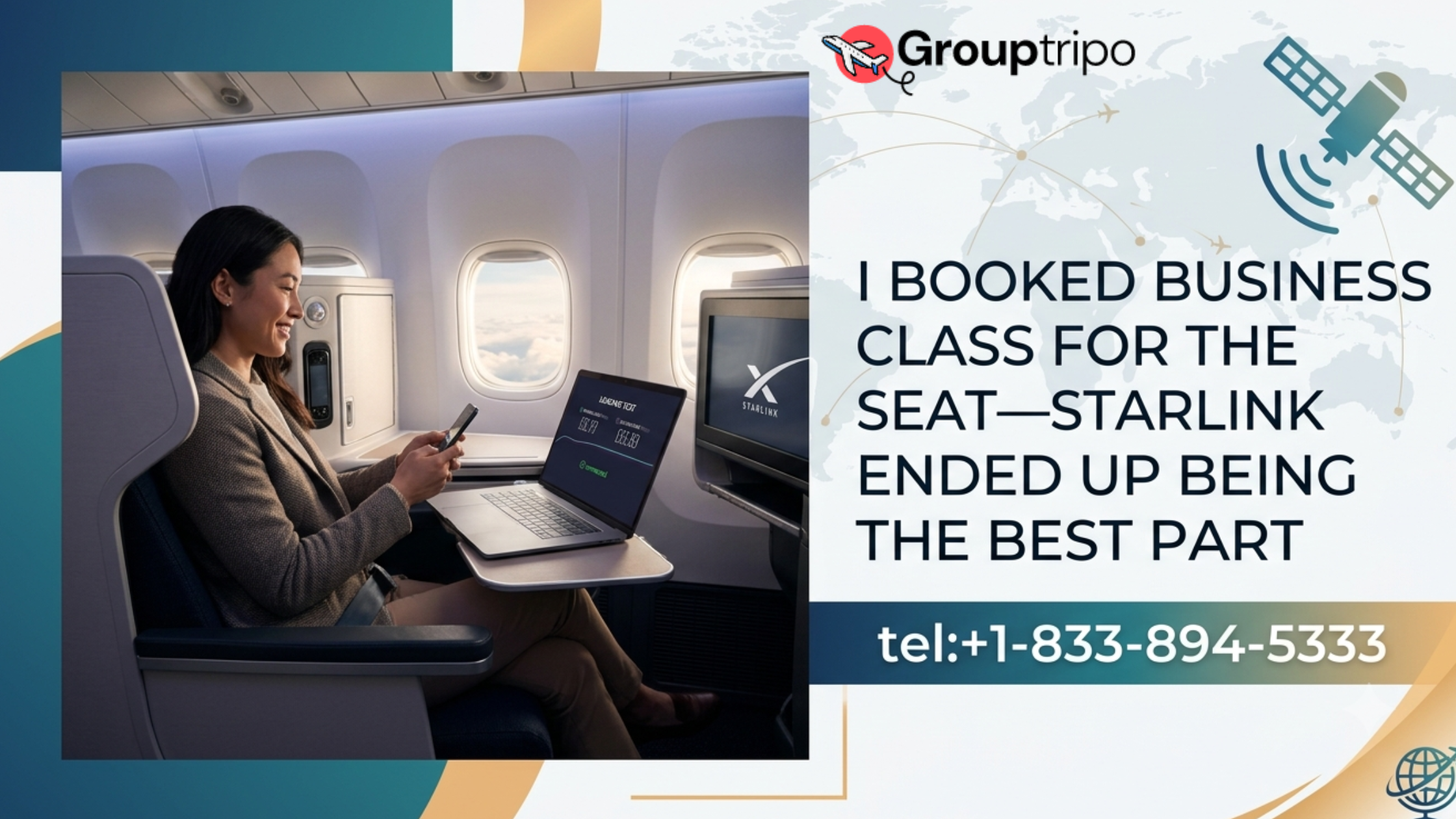
I'll be straightforward: when I upgraded to business class on a transatlantic leg last spring, the connectivity wasn't what I was thinking about. I wanted the flat bed, the meal service, the quiet. But somewhere over the mid-Atlantic, I opened my laptop expecting the usual crawl—and instead watched a 4K YouTube clip buffer-free at 35,000 feet. That was the moment I started paying closer attention to Starlink aviation and what it actually means for business travelers in the premium cabin.
This guide covers what I've learned since then—from talking to airline reps, cross-checking flight specs, and yes, a few more long-haul flights specifically chosen because of their Wi-Fi setup.
Why Starlink Changes the In-Flight Internet Equation
Conventional in-flight Wi-Fi runs on geostationary satellites parked roughly 35,000 kilometers above Earth. The physics of that distance introduces latency—typically 600–800 milliseconds—that makes video calls choppy, cloud tools sluggish, and VPNs nearly unusable. Most business travelers learned to treat inflight Wi-Fi as a last resort, something for checking email subject lines and nothing more.
Starlink's low-earth-orbit (LEO) constellation sits at around 550 km—a fraction of the distance. The result is latency in the 20–40 ms range, which is comparable to a solid home broadband connection. The difference isn't incremental; it's categorical. Real-time video conferencing, uploading large files, using browser-based design tools—all of this becomes realistic on a plane equipped with Starlink aviation internet.
For business-class passengers specifically, this matters more than it might seem. A premium seat costs anywhere from $2,000 to $12,000+ depending on route and carrier. If you're flying on a work trip, the ability to actually work during those 8–14 hours isn't a luxury—it's the justification for the spend. Starlink wifi on international business class flights is beginning to shift the calculus on which airlines corporate travel teams prefer to book.
Speed Context
Legacy Ku/Ka-band inflight Wi-Fi: typically 3–15 Mbps shared across the aircraft, with 600+ ms latency.
Starlink aviation business class internet speed: 50–200+ Mbps per aircraft, 20–40 ms latency, stable over polar and oceanic routes.
Even when shared across a full widebody, Starlink allocates bandwidth differently—and business cabins often receive preferential QoS (quality of service) routing.
Which Airlines Are Actually Offering Starlink in Business Class Right Now
This is where things get complicated—and where a lot of travelers waste time. The answer isn't a clean list you can bookmark, because airlines with Starlink wifi business class configurations change constantly. Airlines roll out hardware by tail number, not fleet-wide overnight. A carrier might have Starlink on 30% of its widebodies while the rest still run the older system, and there's often no visible way to tell when booking which aircraft you'll actually board.
That said, here's what the landscape looked like as of mid-2026:
JSX and Surf Air were early adopters in the regional space, running Starlink on their smaller cabin aircraft—providing an outsized per-passenger bandwidth that's genuinely impressive. Hawaiian Airlines completed a fleet-wide rollout across its long-haul equipment. Air New Zealand began installing Starlink on its widebodies, making its business class product—already well-regarded for lie-flat seats—even more compelling for productivity-focused flyers. Several charter and private aviation operators have made Starlink aviation premium cabin connectivity a selling point for UHNW clientele.
On the legacy carrier side, rollouts have been slower due to fleet size and regulatory certification timelines. But pilots at multiple major U.S. carriers have confirmed installations are underway, and announcements are expected throughout 2026. The honest answer: if you need to know whether a specific itinerary has Starlink in the business cabin, the most reliable path is calling +1-833-894-5333 and asking an agent to verify the aircraft configuration before you book or upgrade.
Want to confirm if your specific route has Starlink in business class? Agents can check live fleet configurations and help you select the right itinerary. +1-833-894-5333
Understanding the Real Cost: Starlink Aviation Business Class Price Breakdown
When people search for Starlink aviation business class price, they're usually conflating two separate cost conversations: the price of the business-class ticket itself, and the cost of Wi-Fi access during the flight. These are distinct, and confusing them leads to unpleasant surprises.
On the ticket side, business class flights with Starlink internet don't carry a Starlink premium—at least not explicitly. Airlines don't line-item it the way you'd see a checked bag fee. What they do is use connectivity as part of the overall product pitch. So you're paying for business class, and Starlink is a feature of the cabin, the same way lie-flat seats and Champagne are.
On the access side, it varies significantly by carrier. Some airlines—particularly those newer to premium markets—include Wi-Fi in the business class fare entirely, treating it as an amenity rather than an add-on. Others charge a session or day pass that ranges from $12 to $50+. A handful tier it: lighter plans for messaging and email, higher-cost plans for streaming and video calls.
The Starlink aviation business class cost that matters most to most travelers is: "Will I be able to do my work without paying extra on top of my premium fare?" The answer depends entirely on the carrier. This is worth confirming explicitly before you fly, because the fine print varies significantly and inflight Wi-Fi menus aren't always consistent with what's described online.
What to Ask Before You Book
Does this specific route/aircraft have Starlink or a legacy system?
Is Wi-Fi included in the business class fare or charged separately?
Are there bandwidth restrictions on video calls or streaming even with Starlink?
Does the business cabin get prioritized bandwidth allocation?
How to Book or Upgrade to a Business Class Flight with Starlink Wi-Fi
Identify your route and likely aircraft typeStart with the airline's website and look up the equipment scheduled for your flight. Widebody aircraft—Boeing 787, 777, Airbus A350, A380—are the most likely candidates for Starlink aviation installation on international routes. Narrowbodies on domestic legs are less common but not unheard of.
Cross-check the in-flight connectivity specsMost airlines list their Wi-Fi provider on their website under "in-flight amenities" or in the seat map tool. If it says "SpaceX Starlink," you're set. If it says "Viasat," "Gogo," or "Panasonic Avionics," that's a legacy system. If it says nothing—call and ask directly.
Book the appropriate business class fare classFor Starlink business class flight booking, pay attention to whether your fare class allows upgrades, mileage accrual, and same-day changes. A lower-priced "W" or "I" fare might restrict you from getting the best seat assignments even in the same cabin.
Consider upgrade pathways if paying full business class feels steepPoints upgrades, bid upgrades, and complimentary elite upgrades can all land you in the business cabin. The key question: does the upgrade confirm you into the Starlink-equipped aircraft, or does equipment swap risk apply? This is exactly the kind of nuance agents at Starlink aviation customer service lines can help you navigate.
Confirm connectivity before day of travelAircraft swaps happen. If your productivity plan depends on Starlink connectivity, call the airline 24–48 hours before departure to verify the equipment hasn't changed. Some travelers do this routinely on work trips—it takes three minutes and avoids a nasty surprise at 40,000 feet.
Connect and authenticate once airborneOn Starlink-equipped aircraft, Wi-Fi portals load faster than legacy systems and authentication usually completes in under 60 seconds. Set up your VPN, open your work tools, and run a quick speed test—100 Mbps+ is realistic on a lightly loaded flight.
The Starlink Aviation Business Class Experience: What's Actually Different
Speed numbers are one thing. What does the Starlink aviation premium cabin experience actually feel like in practice? I've flown it enough now to have a clear picture.
The most immediate difference is that you stop bracing for failure. Anyone who's tried to join a video call on traditional in-flight Wi-Fi knows the anxiety—the spinning cursor, the dropped frames, the apology to the client on the other end. With Starlink, you join the call normally. You mute yourself if there's background noise. You share your screen. It's a meeting. This sounds unremarkable until you remember that it was genuinely impossible at altitude 18 months ago for most travelers.
The Starlink wifi business traveler guide reality is that you can realistically plan your inflight hours as productive work time rather than dead time. Eight hours from JFK to LHR becomes eight hours you can use. For frequent business travelers, that's not a small thing—it's potentially dozens of recovered work hours per year.
The secondary effect is that the business cabin becomes quieter in a different way. People are actually working or watching their own content rather than being trapped by connectivity limitations. The ambient stress of "will this work?" disappears.
Where limitations still exist: during peak boarding and landing periods, some Starlink aircraft restrict connectivity for FAA compliance reasons. A handful of carriers still throttle streaming video even on Starlink. And if you're flying a route with an older aircraft swap, you lose the benefit entirely—which is why confirming equipment matters.
Need help finding routes with confirmed Starlink in business class? Agents track fleet rollouts in real time and can suggest alternatives if your first choice doesn't have it. +1-833-894-5333
Starlink Business Class Seat Upgrade Cost: What You'll Actually Pay
The Starlink business class seat upgrade cost question comes in two flavors: what's the premium over economy to get into a business cabin that has Starlink, and is there a surcharge for Starlink access once you're seated?
On the first question, business class pricing varies wildly by carrier, route, and booking window. A domestic U.S. business class seat might start at $400–800 more than economy. A transatlantic business class can be $2,000–6,000 above the cheapest economy fare. There's no line item for Starlink—it's part of the product you're paying for when that aircraft has it installed.
On the second question—the Wi-Fi access charge—this is where travelers often get surprised. Even in business class, not every airline includes Wi-Fi in the ticket. Some charge $18–35 for a session pass or $25–50 for full-flight access. A growing number of carriers include it free for business class passengers as a deliberate differentiation move. The only way to know for certain on your specific flight is to ask before you book—because the airline's website often reflects a general policy that doesn't match what you'll see in the inflight portal.
Points-based upgrade pathways deserve a specific mention here. If you hold elite status with a carrier or have accumulated miles, a Starlink business class seat upgrade via points can get you into the premium cabin for a fraction of the cash price—sometimes as low as 30,000–60,000 miles on partner awards. The catch is that award availability for upgrades is controlled by the airline's revenue management system, and availability on Starlink-equipped aircraft specifically isn't tracked separately. This is one of those cases where talking to a live agent—rather than clicking through an award search tool—surfaces options the website won't show you.
Common Assumptions That Lead to Disappointment
Mistake 1: Assuming all business class flights have Starlink. They don't. Fleet retrofits take years. Even on carriers that have announced Starlink partnerships, individual aircraft may still be running older systems. Always verify the specific tail.
Mistake 2: Assuming Starlink means free Wi-Fi. The satellite system and the pricing model are separate decisions made by the airline. Starlink provides the pipe; the airline decides how to charge you for it.
Mistake 3: Trusting seat comparison sites for connectivity data. Sites like SeatGuru are invaluable for seat dimensions, but their connectivity data often lags the actual fleet by 6–18 months. Use them for seat selection, not for Wi-Fi confirmation.
Mistake 4: Booking a "Starlink route" without checking for equipment swaps. Airlines change aircraft. If your flight shows a 787 on booking and gets swapped to an older 767, your Starlink experience disappears. Check again 24–48 hours before travel.
Mistake 5: Expecting identical speeds across all Starlink flights. Starlink allocates bandwidth to the aircraft as a whole. During off-peak flights, speeds can be extraordinary. On full widebodies at peak hours, throughput per device will be lower—though still vastly better than legacy systems.
Mistake 6: Planning a critical client call without a backup plan. Starlink is reliable, but aviation connectivity is never 100% guaranteed. Always have an offline version of what you need—downloaded documents, an offline presentation, notes that don't require a live internet connection.
When Calling Beats Clicking: The Human Advantage in Premium Booking
A colleague booked a business class ticket on what she confirmed—via the airline's own website—was a Starlink-equipped aircraft. The seat map showed the right plane. She planned her entire itinerary around four hours of live client work during the flight. At the gate, she noticed the boarding pass showed a different aircraft code. The website had reflected the original equipment; the swap had happened quietly 36 hours earlier. She'd been on hold with the online chat bot for 20 minutes before giving up.
The solution came from a quick call to a live agent—who confirmed the swap, flagged an alternative departure on the Starlink-equipped aircraft the following morning, and held the seat while she checked with her client. Total call time: 8 minutes.
— Business traveler, JFK-LHR route, March 2026
Here's the consistent pattern with Starlink aviation customer service situations: the agents who handle premium bookings have access to fleet configuration data, equipment substitution histories, and upgrade inventory that simply doesn't surface in online booking tools. They can see when an aircraft was last retrofitted, which tail numbers carry Starlink on a given route, and whether an upgrade will survive a likely equipment change.
The starlink aviation phone number for booking and upgrade assistance is +1-833-894-5333. Best times to call are generally mid-morning on weekdays—typically 9 AM to 11 AM Eastern—when hold times are shorter and the most experienced agents tend to be on shift. Avoid the 30 minutes before and after flight departure windows, which flood the queue with same-day emergency calls.
Sample Call Script — Use This Word for Word If Helpful
"Hi, I'm looking at booking [or upgrading to] business class on [route/flight]. Before I confirm, can you tell me which aircraft is scheduled for this departure and whether it's equipped with Starlink Wi-Fi? I need reliable connectivity for work calls during the flight, so I'd also like to know if there have been any recent equipment swaps on this route. And can you confirm whether Wi-Fi is included in the business class fare or charged separately?"
That's it. A good agent will answer all three questions in under two minutes, and you'll know exactly what you're booking before any money changes hands.
Get real answers before you book. Live agents can verify Starlink availability on your specific flight and help you navigate upgrade options that aren't visible online. +1-833-894-5333
Best Airlines Offering Starlink Business Class: What to Look For
Rather than a static list that will age poorly, here are the markers that distinguish the best airlines offering Starlink business class for serious business travelers:
Fleet commitment, not just announcement. Several carriers have issued press releases about Starlink partnerships without specifying timelines or fleet percentages. What you want is a carrier that has completed installation on the specific aircraft type serving your route—not one that plans to someday. Ask specifically: "Has this tail number been retrofitted with Starlink?"
Business class Wi-Fi included in fare. The most business-traveler-friendly carriers treat connectivity as a core business class amenity, not an upsell. If the airline charges separately for Wi-Fi even in business, that's a product decision that reveals something about how they think about the premium cabin.
Dedicated bandwidth allocation for premium cabins. Some carriers specifically configure their Starlink setup to prioritize business class passengers in terms of QoS. This matters on full flights—a 787 with 36 business class seats and 200 economy seats represents very different per-user bandwidth depending on allocation policy.
Transparent route-level disclosure. The starlink aviation business class airlines worth booking are the ones whose agents can answer the equipment question in under 60 seconds. If an agent can't tell you what Wi-Fi system is on your specific aircraft, that's a signal about how the airline trains and equips its customer service team.
Frequently Asked Questions
What is Starlink aviation business class and how is it different from regular inflight Wi-Fi?
Starlink aviation uses SpaceX's low-earth-orbit satellite network to deliver internet to aircraft. Unlike traditional geostationary satellite systems—which suffer from high latency (600+ ms) and limited bandwidth—Starlink offers 20–40 ms latency and 50–200+ Mbps per aircraft. In business class, this typically means usable video conferencing, fast file uploads, and reliable cloud tool access that simply wasn't possible with older systems.
How do I know if my business class flight has Starlink?
Check the airline's seat map tool for the aircraft type, then look under "in-flight connectivity" to see the listed provider. If it shows SpaceX or Starlink, you're confirmed. If unclear, call the airline directly and ask which Wi-Fi provider is installed on the specific tail number assigned to your flight. Aircraft swaps can change this up to 48 hours before departure.
Is Starlink Wi-Fi free in business class?
It depends entirely on the carrier. Some airlines include Wi-Fi as part of the business class fare. Others charge a session or day pass ranging from $12 to $50+. Confirm the access policy with the airline before you fly—don't rely on the general website, which may describe fleet-wide policy that doesn't match your specific aircraft or fare class.
Can I make video calls in business class using Starlink?
Yes, on most Starlink-equipped aircraft, video calls are technically feasible in a way they weren't on legacy systems. Latency is low enough for real-time conversation. Some airlines restrict video-call-quality streaming in their plan tiers, so check whether your access plan includes unrestricted bandwidth or is throttled above a certain usage threshold.
What's the Starlink aviation phone number for booking assistance?
For booking and upgrade help on flights with Starlink aviation business class connectivity, call +1-833-894-5333. Agents can verify equipment configurations, check upgrade availability, and help you avoid aircraft swaps that would eliminate the connectivity you're counting on.
How do I upgrade to a Starlink business class seat?
Starlink aviation business class upgrades follow standard upgrade processes—points, bid upgrades, or elite status complimentary upgrades. The key is confirming the upgrade lands you in the Starlink-equipped aircraft. When booking or requesting an upgrade, explicitly ask whether the assigned equipment is confirmed and whether it carries Starlink. An agent can flag if a likely swap might affect your connectivity before you commit.
The Bottom Line for Business Travelers
Starlink has genuinely changed what's possible at altitude—but the gap between "this airline has Starlink" and "this specific flight I'm about to board has Starlink in business class" is wider than most travelers expect. Equipment rollouts are uneven. Pricing models vary. Aircraft swaps are common. The travelers who consistently get the experience they're paying for are the ones who verify equipment, confirm access policy, and don't assume the booking tool has surfaced everything worth knowing.
If you're planning a work-critical international trip and connectivity matters, five minutes on the phone before booking saves hours of frustration in the air. Call +1-833-894-5333 — Get Flight Details Right